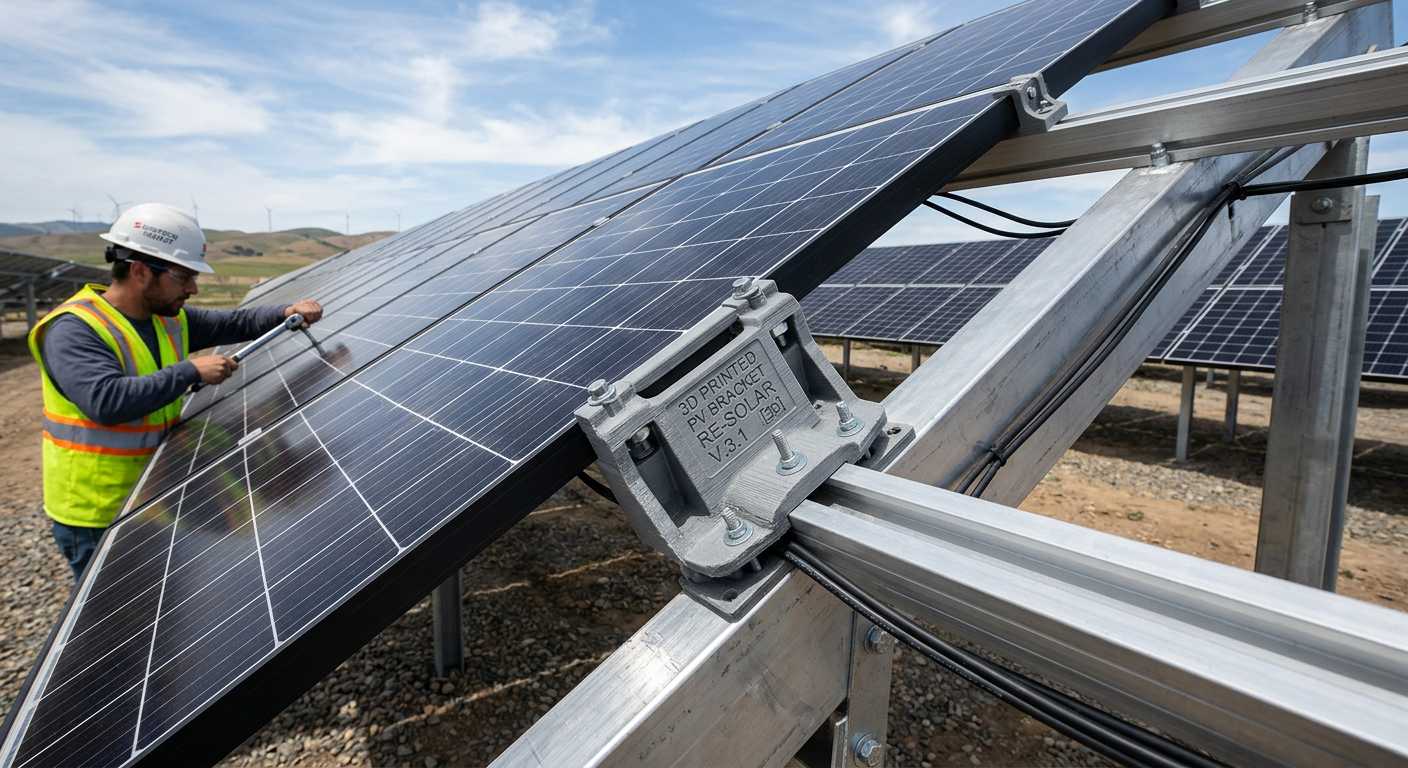
A solar panel mount is expected to last 25 years in full sun exposure. Most 3D printing materials are not designed for this. PLA yellows and embrittles within months. Standard ABS chalks and cracks. Choosing the right material is the difference between a durable custom component and a field failure.
The UV Degradation Problem
UV radiation (particularly UVB, 280–315 nm) cleaves polymer chains, causing:
- Discoloration and surface chalking
- Embrittlement and reduced impact strength
- Dimensional creep under sustained mechanical load
- Loss of tensile strength (up to 50% in PLA after 12 months outdoor exposure)
Recommended Materials by Application
| Application | Material | Why |
|---|---|---|
| Non-structural clips, covers | ASA (Acrylonitrile Styrene Acrylate) | Best UV resistance of commodity FDM |
| Structural brackets, mounts | SLS PA12-GF (glass-filled nylon) | UV-stable + load-bearing |
| High-temp environments (>120°C) | PEEK | Continuous 250°C rating, inherent UV resistance |
| Lightweight field hardware | Carbon fiber PETG or PA | Good UV resistance, 40% weight reduction |
| Optical CSP components | SLA + UV-cured coating | High-res surface + UV protective topcoat |
ASA: The Outdoor FDM Standard
ASA (acrylonitrile styrene acrylate) was developed specifically as a UV-stable alternative to ABS. It maintains 90%+ of tensile strength after 1,000 hours of QUV accelerated weathering (equivalent to ~5 years outdoor exposure). For solar mounting clips, conduit fittings, and enclosure covers that experience moderate mechanical loads, ASA is the appropriate choice. Print temperature: 230–250°C. Enclosure required (warping without heated chamber).
PEEK for Extreme Environments
PEEK (polyether ether ketone) is the gold standard for outdoor structural polymer components. Continuous service temperature 250°C, resistant to UV, hydrolysis, and most chemicals. The limitation: print temperature 360–400°C requires a high-temperature printer (Stratasys Fortus, Ultimaker S5 HT, or equivalent). Cost is 10–20× ABS per kg. Appropriate for hardware that experiences both structural loads and thermal cycling in desert environments.